Dealing with Adversity: Aikido, On and Off the Mat (Part II)

(This is Part II, to a three part article. You can find Part 1 here: Part 1)

In plain language, I was getting my ass kicked, as if three ukes during randori were successful in tackling me and taking me to the ground. It was an ugly feeling and I knew that something had to change. I decided to take a leave from my teaching job, in order to get a handle on my health…and to find my balance. I moved in with my dad, back to my hometown of Fresno, CA, and used the time off work to get ample rest and do things that I enjoyed.  
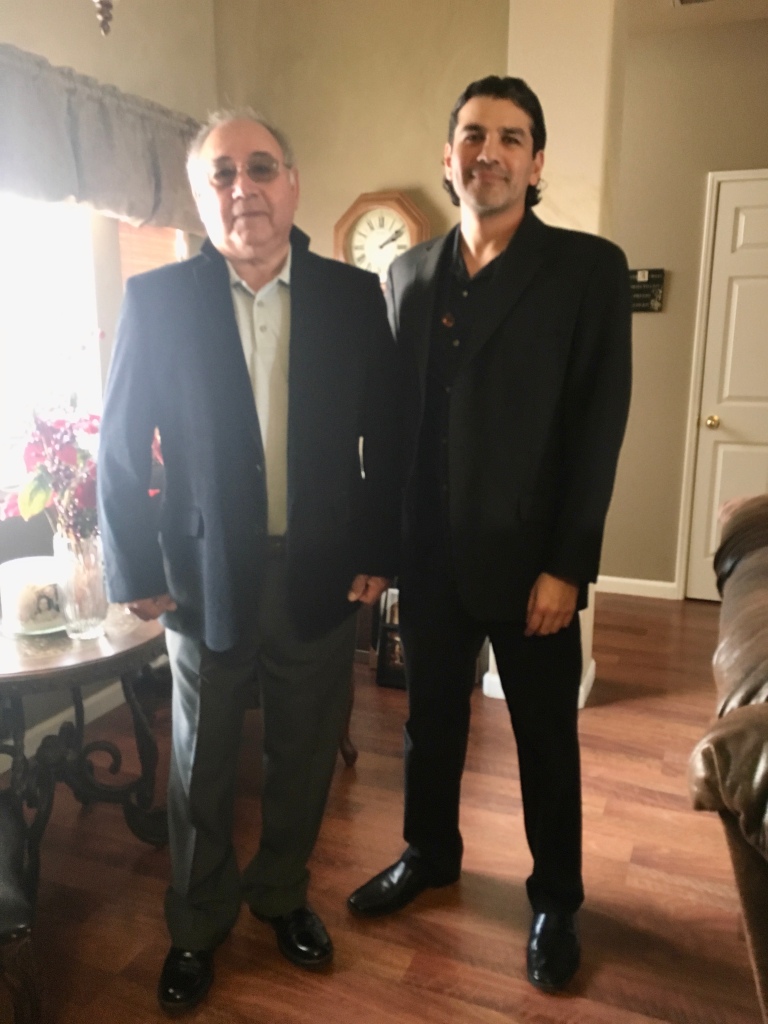
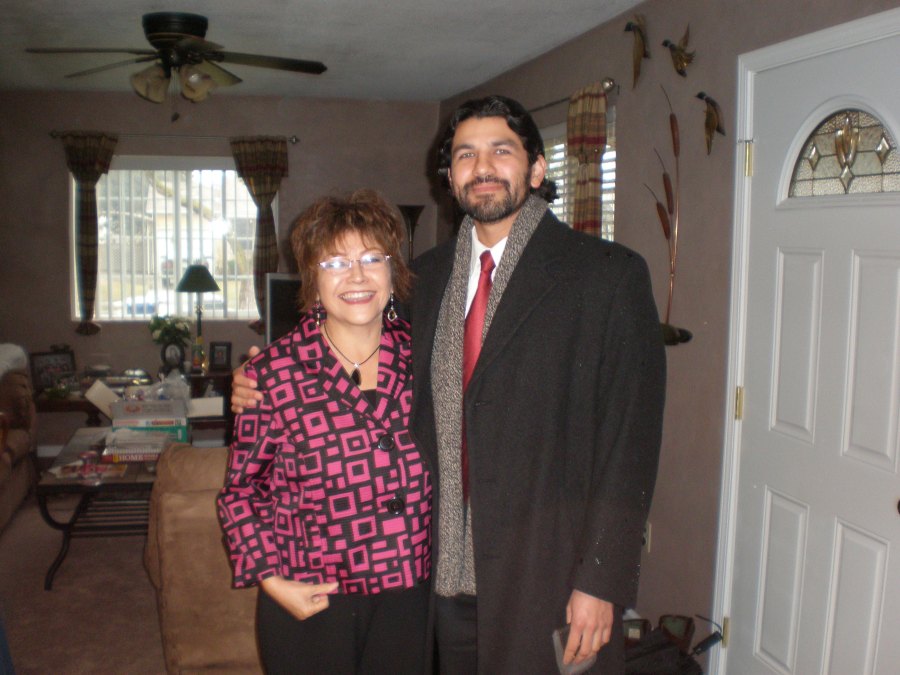
My dad and I dressed up to watch a show.

I went fishing as much as I could, exercised at the gym a few days a week, meditated, trained at the local Aikido dojo and made sure to take naps. I, also, enjoyed being around my family more. In fact, it was the first time, since I moved away from college, I was able to spend regular quality time with my dad. While I felt guilty about it at the time, I didn’t spend a lot of time with my mom, however. Being around her was just too stressful and sad.

After what would be a six-month break, I gained my weight back and my panic attacks even stopped. I had stopped taking the anti-depressant I was prescribed before I took my leave, since I didn’t think it was working well enough. I was hoping time off work and doing adequate self-care would be more effective in helping me and I was right! I promised myself I would never get as overwhelmed ever again.

2013 arrived and I was back working and living in the Bay Area. Fortunately, for my family, my mom would find regular housing, however temporary, starting that year. This would reduce my stress of course, but there would still be plenty of crises times and they would take a myriad of forms.

As I had been doing for years already, I talked to my mom almost every day to monitor her and express my love and support. My sister and I would drive hundreds of miles to visit her on special occasions, like her birthday, and holidays, like Thanksgiving and Christmas. And I would do my best to advocate for her at times of crises. Trying to get my mom adequate care and treatment at hospitals would become a regular occurrence, as her physical health steadily deteriorated.

In 2013, my mom was hospitalized after experiencing dizzy spells and a possible stroke. I took the four-hour drive to Bakersfield to be by her side. Fortunately, her attending doctor was responsive and assuring. The same can’t be said for the hospital administration, however.

My sister visiting our mom in the hospital.

The attending doctor wanted my mom to start taking insulin. There was one problem with that, though. My mom had recently developed cataracts. She needed assistance, since she was unable to administer insulin shots to herself. To my relief, the attending doctor referred my mom to an assisted living facility, as part of my mom’s treatment plan upon discharge.

The day after I returned to San Francisco, however, my mom told me they hospital was getting ready to discharge her back to her apartment. I was stunned and angered. I called the hospital and asked to speak to the main administrator.

Now, while my aikido training helps teach me stay “centered and relaxed” when dealing with stress and conflict, ultimately, we train in order to avoid conflict and create harmony with things around us. In fact, aikido translates to “the way of harmony with universal energy or spirit.” With aikido training, like in randori, we try to “harmonize” with the energy of the ukes and redirect them in order to minimize harm and produce a better outcome for all parties.

Applied to day-to-day life experiences, this means we should try and find compromise and mutually beneficial arrangements with people we experience conflict with. However, as I’d experience countless times, too many healthcare workers and authority figures were not only indifferent to my family’s plight, but too many were more than willing to jeopardize my mom’s life. They would do this even when it violated their own workplace policies and the law.

Given this, there was no “harmonizing” in these situations, since our interests were so diametrically opposed. I wanted and needed immediate help and support for my mom. Like all human beings, she deserved to be treated with dignity and respect. In contrast, too many healthcare and government workers treated her as an inconvenience, or worse, a drain on their time and society’s resources.

At times, I would assert myself strongly, from day one of a hospitalization, by letting hospital personnel know I wasn’t going to accept premature discharges of my mom. Hospitals had no qualms about doing so.. I’d even threaten hospital personnel, county workers and even the police with lawsuits or negative media attention when they’d refuse to give my mom, or take her in for, proper medical care (I just started filming and recording my interactions with healthcare and governments workers, I got so fed up.).

Sensei Jaime Calderon showing how to use an “atemi.”

Asserting myself in these ways could be seen as forms of escalation, which is not very “aikido like.” In a famous quote, the founder of aikido, Morihei Ueshiba, said, “To injure an opponent is to injure yourself. To control aggression without inflicting injury is the Art of Peace.” I considered things that I did or said as being consistent with aikido principles and values, though. In aikido, we use what are called “atemis.” They are strikes to knock an attacker off balance, in order to create space and the opportunity to execute a technique or throw. When it comes down to “life and death”, I think strong atemis are essential. I delivered strong atemis whenever I could to protect my mom and I didn’t, nor do I still, feel bad about it.

— To Be Continued —

Dealing with Adversity: Aikido, On and Off the Mat (Part I)

A few months ago, in August, when visiting my extended family in Bakersfield, CA, to my surprise, two of my older cousins asked me to show them some self-defense techniques. I have been practicing Aikido for many years, but they have never asked me to do that before when visiting. The difference is I recently earned a black belt. Being a black belt confers considerable respect it seems.

I indulged my cousins by showing them a few techniques. They especially liked a deflection I showed them off a punch. When Aikido techniques are done proficiently, the force or energy of the “attacker” gets redirected and there is a moment the attacker is off balance and vulnerable. My cousins thought my deflection from a punch was “way cool.”

While Aikido can be used for self-defense, experienced Aikidoka (i.e. Aikido practitioners) know it is more useful than that. Aikido can, also, be used in everyday life. For me, what I went through in trying to support and get help for my gravely disabled mother felt like a marathon version of what we call “randori” in our training.

An Aikido Demonstration of Randori

Randori consists of multiple attackers (the “ukes”) going after one person (the “nage”). The goal of the nage is to avoid being stopped or taken down. The stress and chaos one can experience as nage can be intense. I have trained at some dojos where ukes are expected to run full speed and tackle the nage.

Randori is the most challenging part of Aikido training. Some would say it is “the essence of the training”, as it requires proficiency in many areas of Aikido to be successful. For even a highly skilled black belt, dealing with multiple ukes, typically three or four, constantly attacking gets tiring, physically and mentally. Indeed, seeing my mom’s physical and mental health worsen over the course of many years felt like a pummeling. Some key events will make the point:

  • In 2007, my mom starts having auditory hallucinations and, at times, exclaims to me and other family members that people are inside her apartment and trying to kill her.
  • In 2010, my mom becomes homeless, living in her car, due to not being able to find a rental because of past evictions.
  • In 2012, my mom falls in a bathtub and fractures her back. Shortly before that, she fell down on a staircase, saying “evil spirits” pushed her down.
  • In 2014, my mom’s physical health begins to greatly deteriorate, due to her medical self-neglect. Regular hospitalizations would begin to occur.
  • In 2015, the week of Christmas, my mom would be medically neglected and abused by a hospital in Kern County. Against my wishes, my mom was unsafely discharged, though she was in an acute psychotic state and could not even walk.
  • I moved my mom in with me in 2016 and would leave my teaching job to be her full-time caregiver. That summer, we would find out my mom had kidney disease and her kidneys were functioning at just 30%.

To be successful in randori, a nage must effectively keep their balance, maintain proper posture, and stay calm and relaxed. Seeing my mom suffer and being pretty powerless to help her, despite my best efforts, taught me the importance of being able to do these things in real life.

Keeping Balance and Maintaining Proper Posture

Me, working hard on having proper posture.

In randori, a nage must move decisively and efficiently in dealing with multiple attackers. A stumble or just being knocked off balance can lead to a nage being taken down. One just need think of how important balance must have been for an ancient samurai on a battlefield. Against many enemy samurai, if a samurai lost his balance in battle, his diminished ability to move or respond could prove fatal.

Proper posture means proper alignment and finding and maintaining balance is virtually impossible without it. To help students visualize and feel proper posture, my Sensei likes to say “imagine a vertical line going straight up and down through one’s center, perineum and head.” Another Sensei tells us to “expand our chest and shoulders and drop our tail bones” to find proper posture.

Maintaining balance and proper posture allow nage to perform technique more effectively, since uke’s energy is redirected and shaped by nage. Proper balance and posture, also, allow nage to better see the “lay of the land”, which opens up the choices available to him or her, essentially.

Stay Calm and Relaxed

Aikido is sometimes called “meditation in motion” and for me, that is certainly true. I discovered at the beginning of my training, back in 2009, that I needed to relax my shoulders in order to let “ki” (i.e. energy) an uke was giving me to flow more freely through and around me. Tension or “muscling up” blocks the energy and can even make it easier for an uke to resist and/or use more force against a nage.

If an uke is stronger than the nage, then the nage is obviously going to be at a huge disadvantage if a physical struggle ensues. And regardless of physical differences, in a randori, any moment of struggle between nage and an uke allows the other ukes to get closer and strike or grab the nage. “Freedom of movement” through relaxation is integral for success in randori.

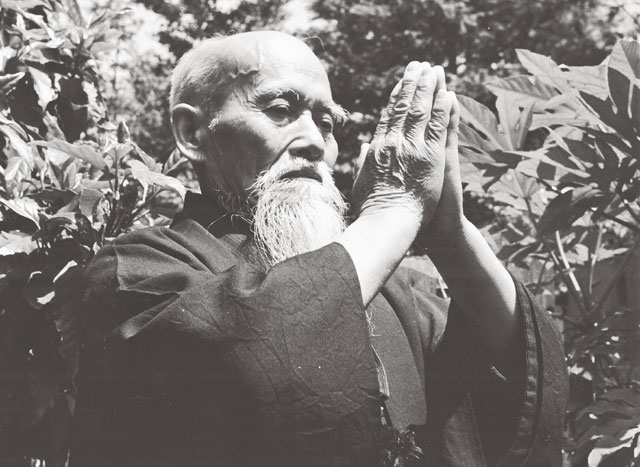
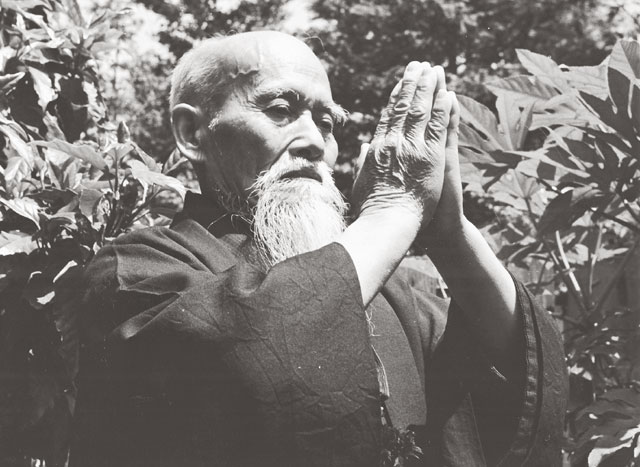
O’Sensei the founder of Aikido, in meditation.

Staying calm and relaxed helps nage be more “present” or “mindful” also. When present, a nage is able to be more attentive and sensitive to his or her surroundings. Indeed, in such a state, the senses are keen and the emotions and even intentions of others are more discernible. From a research paper on “mindfulness”, “The concept of mindfulness….[involves] a highly receptive, nonjudgemental awareness of and attention to whatever is present in the moment – whether pleasant, unpleasant or neutral.”

In terms of execution, a mindful nage is able to make better decisions and act more appropriately, based on the circumstances. Frankly, sometimes the correct response to an uke’s attack can be “soft” and other times it can be “hard.” The nage needs to be able to respond with each and, also, discern when each is appropriate.

Aikido in The Real World

I am pretty proud of my aikido in everyday life today, but there have been numerous times when I have been overwhelmed and distraught in the past. Nobody will be surprised to learn that I ended up hitting some very rough patches, or low points, particularly when my mom was homeless for two years living in her car

Between 2007, when I first started trying to get help for my mom, and 2012, when my mom was in her second year of being homeless, I consumed too much alcohol, had trouble sleeping, had bouts of high blood pressure and started experiencing panic attacks. The stress and worry were too much for me. My doctor would eventually recommend taking an anti-depressant. I vividly remember taking the medication for the first time. As I looked at the pill in the palm of my hand, I thought “I can’t believe I’m taking a psychiatric drug before my mom is.”

–To be continued–

Personal Post: My Aikido Journey

I am hardly posting on my blog, for different reasons. One, work keeps me plenty busy. But I, also, am having a hard time balancing my advocacy, work and personal hobbies. That said, I will be sharing some news about a recent public event I participated in in Modesto, CA. It was the first time my film, “Benevolent Neglect”, was shown in a theatre!

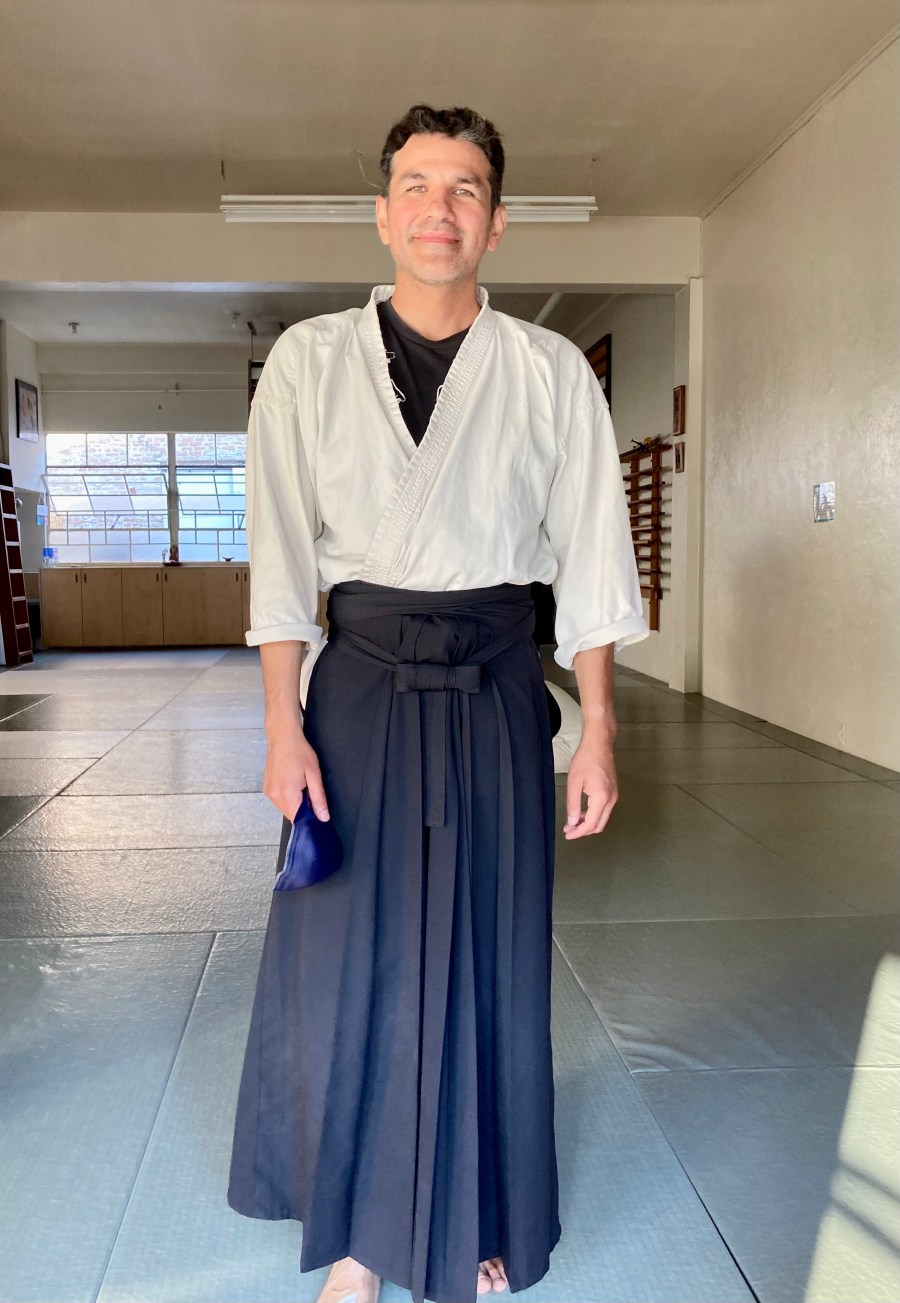
With this post, I’d like to share some important personal news. After an intense amount of training this past year, I was able to finally receive my Black Belt in Aikido. I started training 14 years ago, around the time I first started trying to get help and treatment for my mom. Needless to say, dealing with my mom’s longterm medical crisis and housing insecurity derailed and delayed my training. I started training regularly again in 2019, but then the Pandemic hit! Well, I finally persevered and I know my mom would be very proud of me!

Here’s a video I made of my personal journey in Aikido. I incorporate the personal journey with my mom a little bit.