Like Him or Hate Him, Elon Musk Is Right About Something

The essence of totalitarian government, and perhaps the nature of every bureaucracy, is to make functionaries and mere cogs in the administrative machinery out of men, and thus to dehumanize them.– Philosopher, Hanna Arendt

Donald Trump and Elon Musk have captured headlines with their brazen attacks on various federal departments and programs. In the name of “cutting waste and targeting fraud and bureaucracy,” thousands of federal workers are being laid off, funding has been frozen and cut off to various programs, and the Department of Education has already been singled out for elimination altogether.

(Source: Getty Images)

Musk even recently boasted about all of this by swinging around a chainsaw at a recent CPAC meeting.

There are of course legitimate and persuasive legal, political and even ethical arguments in opposition to what President Trump and Musk are doing, but something important is being missed in the debate. Much, if not most, of the functioning and management of our government have been disgraceful. Albeit, from different vantage points, much of the public knows this too.

In a larger political sense, what President Trump and Musk are doing is bringing a reckoning to our government system. I, for one, think it’s long overdue. Can I have a chainsaw too?!

Cold, Impersonal Bureaucracies

Musk has been explicit about how tyrannical government bureaucracy is. I’d have to largely agree with him, in a particular sense anyways. Bureaucrats are often impersonal and demeaning as hell. This translates to agencies and services, that they are responsible for administering, that are inadequate and demeaning as hell. Two examples will suffice to help make the point.

The first one involves when I first moved my mom in with me in 2016. I desperately needed to enroll my mom into the county mental health program for seniors. Being on Medi-Cal at the time, we had to wait months for Medi-Cal to be transferred from Kern County, where she previously lived, to Stanislaus County, where we resided.

What was supposed to take thirty days took more than sixty. My mom was suffering from her untreated serious mental illness (SMI). I was stressed out. We were indigent, her being on her SSI and me from taking a leave from my job. When I called the county office for what was probably the third time, I sternly admonished the case worker, after she told me the transfer was done, but not active yet.

I indignantly said, “Why don’t you press some damn buttons and make it active or let me talk to your supervisor?” I heard her press some keys on her keyboard and moments later, she told me, “OK. It’s done.” I shouldn’t have had to make that call. We shouldn’t have had to wait so long.

The second one involves my frustration in trying to get adequate pay for being my mother’s caregiver. For the sake of brevity, just know that Medi-Cal, or what’s called In-Home-Support-Services (IHSS), doesn’t pay much for caregiving. A big reason for that is because they severely limit how many hours they pay for each “caregiving duty.”  
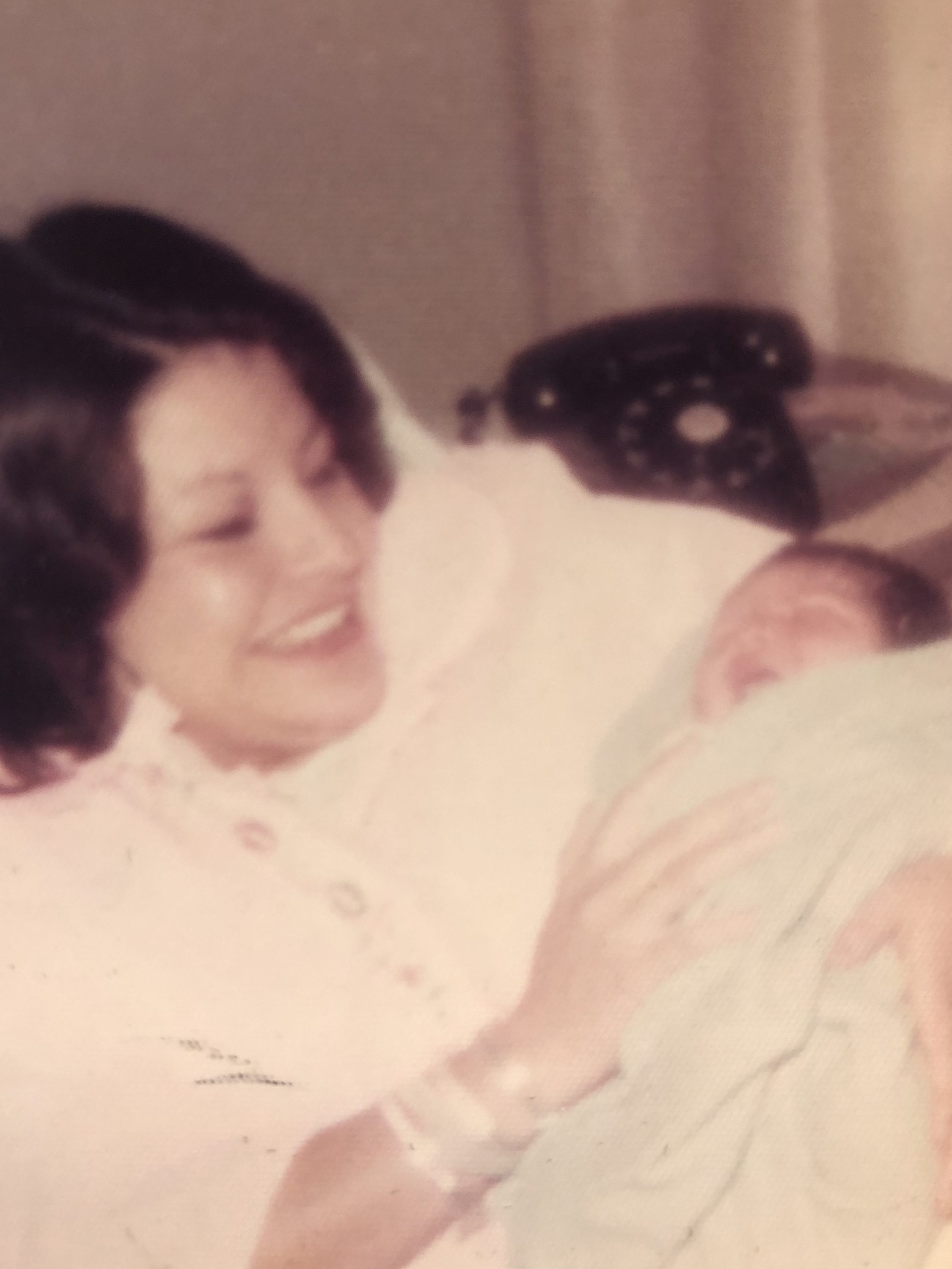
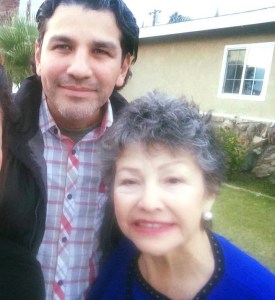
Me and my mom.

To be able “to live” off caregiving, to get paid for 40 hours of work in other words, one must be approved for “protective supervision” duties. Disability Rights California describes it the following way: “Protective supervision is an IHSS service for people who, due to a mental impairment or mental illness, need to be observed 24 hours per day to protect them from injuries, hazards, or accidents.”

My mom suffered from an untreated serious mental illness and would regularly jeopardize her safety and well-being unwittingly. The social worker who interviewed me, however, contorted everything I said, when I gave her examples of what I had to do for my mom, to fit what was clearly a predetermined, disqualifying narrative or script.

When I said I’d have to dissuade my mom from going outside to argue with and/or harass the neighbors, the social worker took that as my mom not needing protective supervision. To the social worker, that was proof “my mom listened to me.” To that, I said, “Well, if she doesn’t listen, then I have to physically try to stop her,” the social worker ignored that part entirely. And what did my mom possibly listening to me have to do with anything? My mom was severely impaired, regardless!

Whether it was that or me having to watch my mom and make sure she wouldn’t leave water running somewhere in the apartment or leave the stove on. Or whether it was having to watch and make sure my mom didn’t throw any of our belongings or her medications away, destroy property, or whether it was waking up multiple times during the night to check on my mom and keep her safe from what she believed were “spiritual attacks,” the conclusion the social worker drew was the same. “So cause your mom listens to you, she doesn’t need protective supervision.” To this, I stated, “Ummm…no. The way I see it. I’m already providing protective supervision and you aren’t paying me for it.”

Needless to say, the county ruled my mom didn’t qualify for protective supervision and I would have my modest savings depleted, as a result. Social worker? Yea right. To me, the woman lost her compassion and care for the people she was supposed to help a long time ago. Instead, she saw my mom as an expense to be avoided. Like an automaton, she advanced the priorities of an unresponsive bureaucracy and was carrying out tasks as if she was programmed.

Indifference and Negligence All Around

County programs and facilities weren’t the only places I experienced gross problems. Hospitals, in one case a private one, were plenty abusive towards and neglectful of my mom. They regularly would try to discharge her prematurely, when she wasn’t even medically stabilized, and would let her or help her leave, despite her being in an acute psychotic state.

Plenty of these times happened in front of me, when I was there acting as her caregiver and “next of kin.” This neglectful and abusive behavior was even more frequent when I wasn’t there, when she was living hundreds of miles away from me. Looking over years of her medical history records showed it being a regular pattern, actually.

President Trump and Elon Musk like to talk about “waste.” Literally, taxpayer money was “wasted,” since my mom would just end up returning after being released from leaving a hospital. She wasn’t stabilized, so her condition would just exacerbate again. It was like a revolving door and got to the point where she was being admitted to hospital emergency rooms, on average, one to two times a month.

Elon Musk (and President Trump by extension) is questioning the value and work ethic of federal workers. Well, I question the value and work ethic of many healthcare workers. I have witnessed firsthand many act unprofessionally and unethically, and many simply aren’t very good at their jobs.

Case in point; towards the end of her life, my mom was hospitalized, after she stopped going to dialysis. A hospital social worker came by the hospital to talk to us and, upon me mentioning I worked in San Francisco, the social worker started commenting on how much San Francisco, in her own words, “smells like pee and is so dirty.”  I’m trying to have a serious conversation about my mom’s fragile health and this is what she says?!  

Minutes into talking about my mom’s psychiatric history, my mom’s kidney doctor walks in and straight up asked the social worker, who had the authority to determine a patient’s mental capacity, if my mom could make decisions for herself. Without even talking to my mom, who happened to be sleeping just a few feet away from us, the social worker said, “No because she has a serious mental illness and is not competent enough.” At that point, I was put in charge of my mom’s medical care.

I was relieved and grateful for that, since my mom didn’t have capacity, but the social worker didn’t follow hospital protocol. In fact, when she brought me a document to sign, giving me decision-making authority, she said, “Your mom has the Right to reverse the decision to put her in hospice care.” I knew what she was saying was untrue and felt like she was just trying to “cover her ass” if need be. I looked at her straight in the face and said, “No she doesn’t. Her doctor was right there as a witness and heard what you determined.”

“Burn It All Down”

So let’s be real. It’s not just the federal agencies and departments that are the problem. State and county governments share the blame and private industry does as well. Given that, I propose 25% of mental health care workers, both government and nongovernment employees, be fired! (Why shouldn’t I be taken as serious as Musk?) And what’s the point of having mental health services and laws available if they aren’t even going to be used to actually help people? As my mom’s kidney doctor said, “Your mom needs psychiatric treatment.” “No shit, doctor!” I exclaimed.

Authorities and healthcare workers should have been more honest and just told me the system isn’t setup to help my mom, instead of trying to give me advice or pretending like there’s actual care. For example, I was explicitly told by a Behavioral Health administrator that they could do more for my mom if she became homeless. Well, she did become homeless, living in a car, and they still didn’t do shit! In fact, a government worker with the California Department of Health told me my mom “technically has a roof over her head” cause she was living in car. Fuck the system all to hell!!!!!  Who is with me?!!!!!

(My solutions are different than Trump’s and Musk’s. Stay tuned for part II…..maybe.)

An Ancient Bridge in Spain and The Scent of My Mother

Me, in front of the “Puerta del Puente”

I recently went on a short trip to Spain with my father. It was the first time for both of us. It was something I wish we could have done ten years ago, when my dad was less physically limited. Unfortunately, back then, in 2012, my mama was homeless, living in her car. So, we were a bit preoccupied, on top of being busy with our jobs.

Though she is no longer with us, my mom isn’t ever too far from our minds. To honor my mom, I was already planning on leaving something of hers in Spain. My mama loved to visit new places and travel, before she got sick. Outside of Mexico a few times, my mom didn’t travel outside the U.S., but I know she would have loved to visit Western Europe if she got the chance.  So, I wanted to leave a part of her there.

The ancient bridge in Cordoba

Not having too much to choose from, I had settled on her watch. I wanted somewhere meaningful to place it, but among the historical sites and places we visited, I had trouble justifying placing it among any of the ubiquitous Catholic edifices or relics. My mom was raised Catholic, but she would come to despise Catholicism. She came to believe the Catholic Church was “The Beast” described in Revelations in the Bible. This was a reflection of my mom’s religious views. She referred to herself as being “nondenominational” and had many criticisms of organized religion.

I was able to find a place in Cordoba, Spain. In Cordoba, there is an ancient bridge. The bridge was built across the Guadalquivir river in the early 1st century BC by the Romans. After the Romans, Muslims settled and dominated the area in the Middle Ages. At that time, it became the capital of “Muslim Spain” for many centuries. Christians (i.e. Catholics) would gain control of the area and in the 16th Century would build a Renaissance gate on one side, the “Puerta del Puente.”

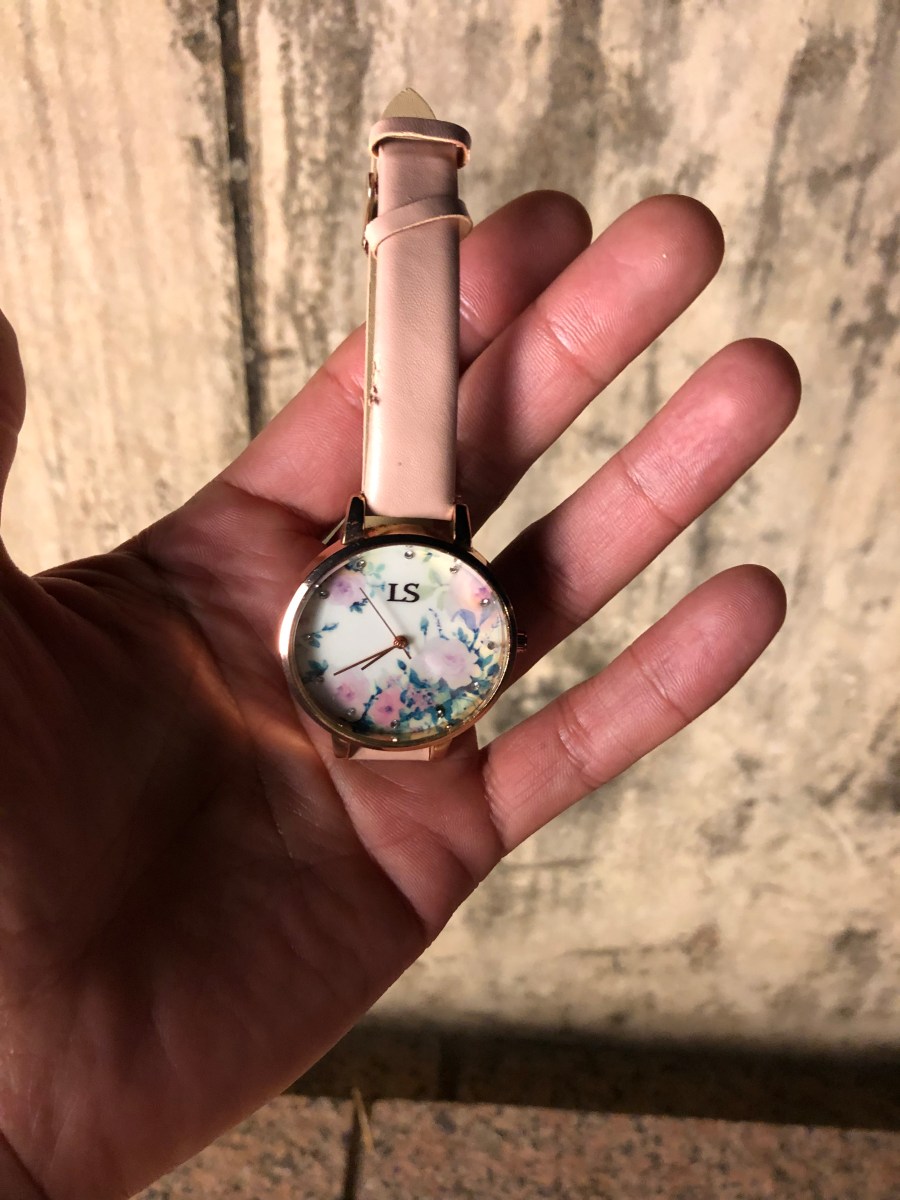
As I learned more about the history of the bridge and the city, I became convinced it would be a good spot to leave my mother’s watch, since it was a place where so much world history, cultural and religious in particular, converged. In that sense, it was not about Catholicism, it was about human history and change. It was about time being impermanent. My mom’s watch stopped working shortly after she passed. But time still presses forward, as it does through all things, including after my mama’s heart stopped beating.  

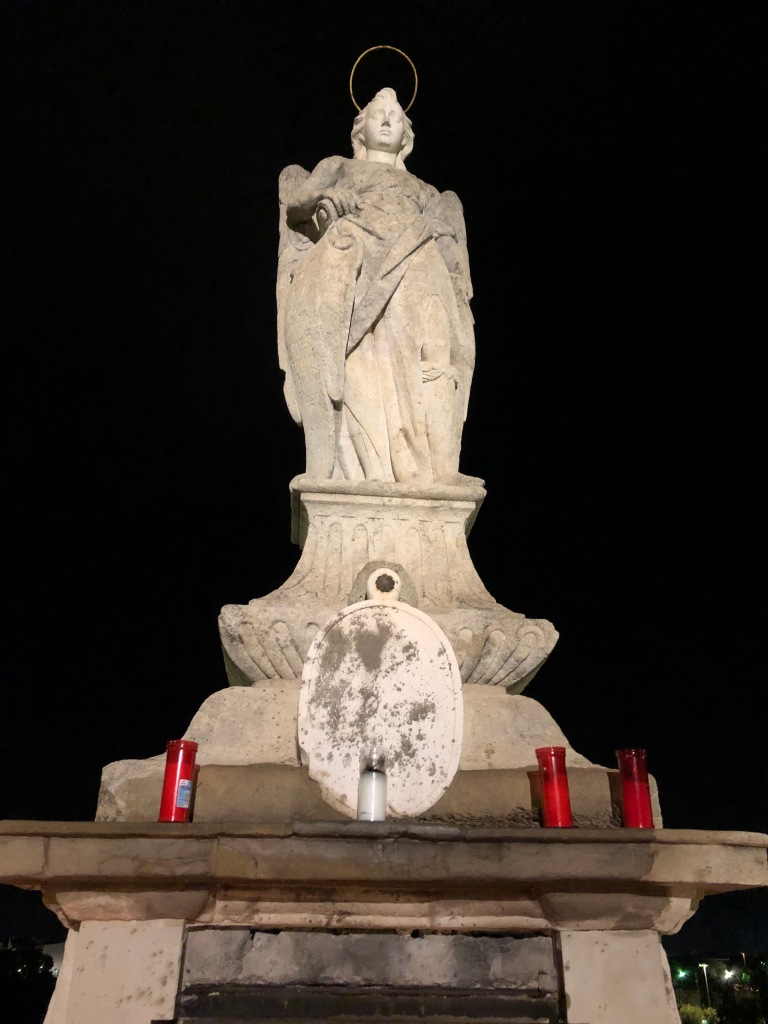
From our hotel, I jogged a mile to the bridge our last day in Cordoba. It was around 7:00am and still dark. The streets were still pretty quiet and a little eerie, but I didn’t mind the cover of darkness. I figured throwing my mom’s watch into the river could be considered “littering” anyways and I didn’t want to attract attention. I stopped about midway on the bridge, near the statue of what I thought was a virgin Saint. There were candles on the ground in front of the statue and a few were lit.

The statue of the Archangel, Saint Rafael

I had planned on doing a bit of a ceremony, something not too different than what I do in my home in the mornings some days. I started by saying to the statue, “I’m sorry, but I don’t know who you are. If you’re able to, I could use your comfort and protection.” Not being Catholic, I didn’t feel I could even ask for that. I was just showing reverence, mainly, since I was a visitor. I then said a short prayer. I asked for guidance from my mom and told her how much we missed her and how I wish she could be there with me. I then prayed a bit to Jesus. I said these prayers while looking out over the water. I could barely see the river in the black and indigo darkness, as the sun just started to make its presence known on the horizon.

I then started to do some chanting meditation. It is what I have been doing and studying a bit, as part of a spiritual and physical practice I am learning through my Aikido training.  Specifically, I did a version of O’Sensei’s Kototama that I was taught by Linda Holiday Sensei recently. It is a standing version that incorporates arm movements.

“Suuuu…….Aahhhh……..Ooooo………..Uuuuu………Eeeeeyyy……..Iiiiiieeeeee”

The vibration it creates in my center (“hara”) helps me feel grounded, present and more relaxed. Spiritually, it is verbal and physical reverence to creation and the universe. Praying I do more out of reverence for my mom and how I was raised. The chanting is something I actually feel that is more relevant to me philosophically. Being based on Eastern Religion, it embodies connection, awareness and harmony (i.e. coexistence) with other living things and nature. Given that there is even Jewish history and influence in Cordoba, I thought it was powerful that at that moment, through my meditation, I was integrating a fifth religious influence into the city.

After chanting, I took a few minutes to take in the moment. A range of thoughts came up, including remembering my dad cynically asking me the day before why I had my mom’s watch with me, to wondering if my mom was on that bridge with me at that moment. Once I felt ready, I took the watch out of my pocket and looked at it one last time. My friend, Shari, bought my mom the watch for what would be my mom’s last Christmas in 2017. I made sure to text and let Shari know, when I got to the bridge, what I was planning on doing. She was very touched and supportive.

I kissed the watch next and, as I did, I smelled the unmistakable scent of lipstick. I knew the watch had a faint scent of my mom, a flowery smell that some of her clothes also have. But I’ve never smelled lipstick before on any of her things. I thought it was interesting and odd, but I did not think too much about it. I know many people would automatically believe that was a sign from my mom, but I had trouble doing so, cause that’s not my belief system. And being gone around twenty five minutes at that point, I was starting to feel like I should hurry to get back to the hotel to have breakfast with my dad. I carefully reached back and hurled the watch as far as I could into the river, hoping it wouldn’t land in too shallow an area. I didn’t see where it landed, but after hearing a splash, I was satisfied.

It was not until I was in a hotel in Madrid later that day that I decided to look up who the statue on the bridge was. It turns out it is a statue of a male figure, Saint Rafael. Saint Rafael is actually an Archangel and is responsible for healing. During the time of the plague, people in Cordoba would credit Saint Rafael with preventing the plague from causing widespread misery and death. The Spaniards placed the statue of him there in the 17th century. And interestingly, a version of Saint Rafael is found in not just Catholicism, but Islam and Judaism as well.

I have no way of knowing for sure if my mom was with me on that bridge. I like to think she was and that she let me know she was there by somehow conjuring a scent of lipstick. Whatever the case, I do know that since returning from Spain, I have felt recharged and I have a vitality that I do not remember feeling before. I am not as irritable and overwhelmed with work and the mundane everyday tasks of life like I usually am. I have been feeling more relaxed and calm. Indeed, the feeling of melancholy I know so well is not as persistent. I have no idea how long I will feel this way. I hope it lasts. I hope I did receive some permanent healing from Saint Rafael and/or the energies and/or gods in that place. In the least, I’ve been given more reason to continue my spiritual practices and to travel in foreign places more. I’m trying to live a fuller and happier life because my mama would want me to.  And, of course, it helps that I do receive what could be signs of my mama being with me.

Mom, I Need Someone to Talk to

This past Friday, the 27th, marked three years and six months since my mama passed. For a time, I’ve been wanting to write a post, a fictional piece, on what it’d be like to have a heart-to-heart conversation with my mama. I figured I’d do it now. What would make it fictional? Because in my fantasy, my mom would be well. She wouldn’t be suffering mightily from her untreated serious mental illness like she was for the last 1/3rd of her life.

By the time I was 24 years old, my mom was beginning to show signs of her serious mental illness. As time went on, and it went untreated, I would have to be extremely careful about what I shared with and told my mom. For one, I didn’t want to cause her any more stress. A stressful situation or event could induce an acute psychotic episode. Two, it could cause conflict with us in some way, since she could integrate anything I’d tell her into her delusional world. For close to a decade, she’d often implore me to quit my teaching job in San Francisco because she didn’t want me to teach “in a city with Satanists,” for example.

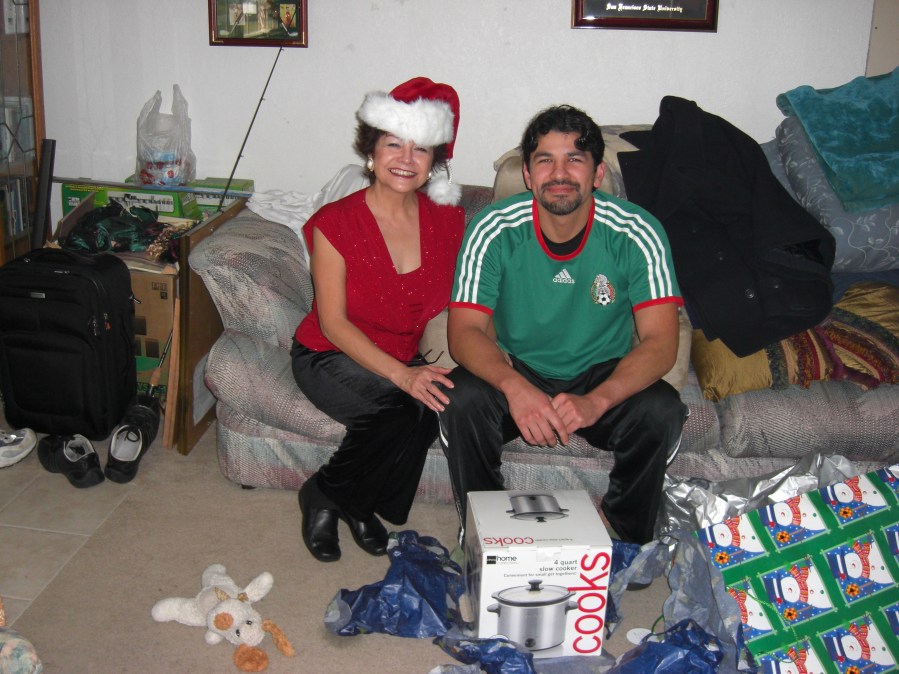
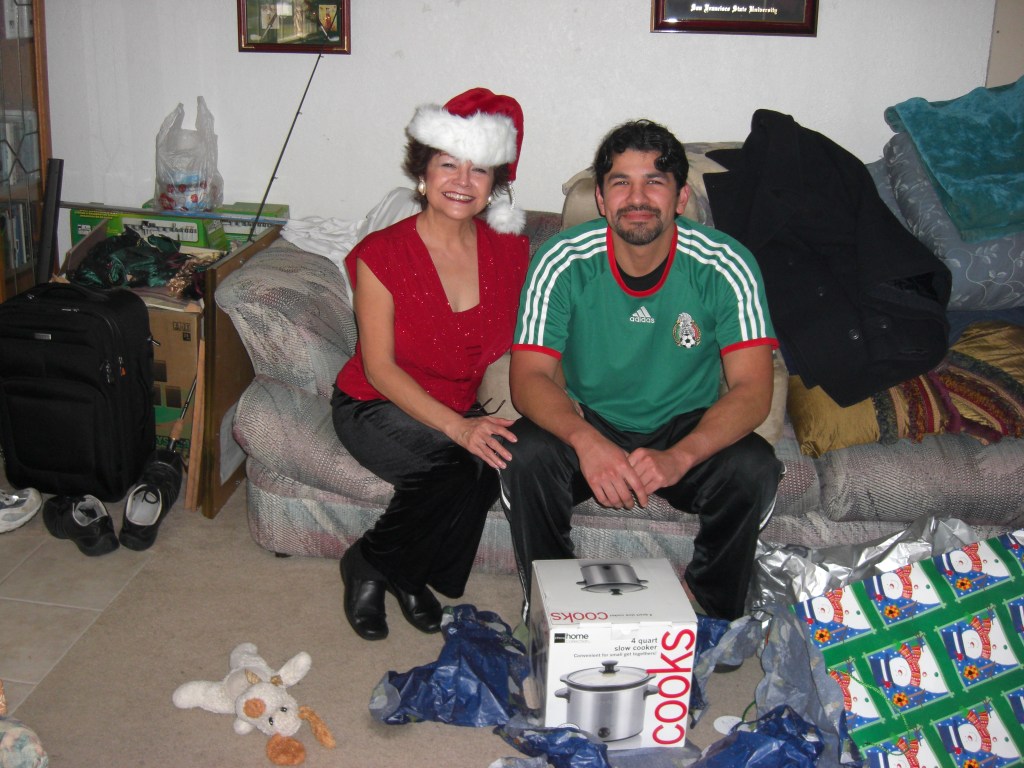
Christmas, 2007

As a grown man, I could have used my mom’s support and advice about such things as work and relationships. I didn’t get that, though. Not the way I should have, anyways. So here is what I imagine a conversation would be like with me and my mom if she was of sound mind.

Me: “Work is a drag. They are cutting our pay substantially. But, of course, I still have as many students as ever in my classes. I’m never going to be able to buy a house in the Bay Area at this point. I’m fed up. The situation sucks the joy out of teaching.”

Mom: “Those devils. They certainly don’t appreciate the work you do as a teacher. You should pray on it and think about what you want to do. And, you know, it’s not too late to go back to school and get your Ph.D!”

Me: “I know, mom. But I don’t want to go back to school. Academia isn’t really for me. I don’t want to be a poor college student again and I can’t really stand the culture. It’s too snobby.  I’ll try to stick it out at work a little longer. You remember how happy I was when I received the job offer?”

Mom: “Yes, of course. And your father and I were very happy for you. I tell everyone I talk to that you’re a community college professor.”

Me: “I know, mom. I was just starting to make pretty good money too, after 15 years of teaching. If I knew when I was 20 years old how much I’d be making, at least before the pay cut, I’d have been thrilled.”

Mom: “You’ll be a success no matter what you decide you want to do.”

Me: “Yea. It’d be nice to find something without the long work hours. Maybe I’ll move back to Fresno soon enough.”

Mom: “That would be nice for your father and I. But what about your female friend? What’s her name again? Stacey?”

Me: “Yes. We aren’t seeing each other anymore. I broke it off before it could get too serious. She was hinting at wanting something exclusive. Ever since my relationship with Marie, I’ve had trouble opening up to women I’m dating.”

Mom: “That relationship was not healthy for a large portion of the time you two were together. That was, also, some time ago now, though. I know your father and I argued a lot in front of you and your sister when we were married, but we did try, as you know. You should try not to repeat our mistakes.”

Me: “I know, mom. You made us go to family therapy. I didn’t appreciate it or really get it at the time, but I think it was admirable and smart for you to do, looking back.”

Mom: “Yes, therapy helped a bit, but your dad was set in his ways and emotionally shut off. He changed when he came back from Vietnam.”

Me: “Yea, when you first told me that, I wasn’t sure whether or not to believe you. But then cousin Melissa confirmed that you said that about dad back then. Whatever it is exactly, it prevents him from even listening to me when I want to talk to him about important things, unless I demand it. I practically have to yell at him to listen to what I have to say sometimes. It’s going to be hard on me if you end up passing before dad. He doesn’t understand me or just the world like you do.”

Mom: “Your dad has a big heart. Just try to be more patient with him and watch your tone when you speak to him. You get impatient quickly with people.’

Me: “I know… that’s what Marie said. That’s what Stacey says. That might be a little bit of what I picked up from dad growing up. I’m trying to improve that.”

Mom: “Maybe go see a therapist. Hahaha”

Me: Maybe…Are you proud of me, mom? At the man that I’ve become at 45 years old?”

Mom: “Yes, of course! Why are you asking me that?!”

Me: “Cause I’m a very different person than I was 20 years ago, even 10 years ago. I have a demanding job with a lot of responsibilities and, I’m not complaining about this, but those years I had to help you when you got sick were hard on me. I feel like I didn’t really enjoy my thirties and now, at 45, I’m single and don’t own a home. It makes me doubt myself.”

Mom: “I’m very proud of you. I couldn’t be prouder. I, of course, wish you would develop a closer relationship with God. But that’s between you and him and I know you try in your way to have a spiritual practice. I think you live by your principles and genuinely care about people and others. And your smart and successful, yet humble and grateful for everything you have. God will continue to bless you because he knows your heart and sees your actions, and I take comfort in that. Knowing he will look after you, even when I’m gone.”

Me: “Well, I’d hope that you’d look after me too, assuming you could from the afterlife.”

Mom: “You may not be sure, but I am. The love I have for you and our family is undying. You’ll see!”

Me: “I know, mom. You are a wonderful mama. You did a great job.”

Mom: “Thank you, mijo.”

Less Blogging, More Film Promotion

I’ve decided to try and convert this blog to a promotional page for my film, Benevolent Neglect. Having a website for my film is one of those marketing aspects I haven’t been able to create yet, given I’m a one person operation and my regular “day job” keeps me way too busy. I’m content with the positive responses my film is garnering, but I know it has the potential to attract a bigger audience. That’s the only way any politicians are going to take it seriously, I figure. I’ve sent it to officials to watch, but haven’t received any response or feedback from them. Typical, I know. In the least, it will give me something productive to do when I feel my advocacy is fruitless. I’m not sure what it’s going to look like yet, but I still plan on blogging on occasion, once it’s converted.

In the meantime, here are some short videos I took when I went to visit my mom at the cemetery on Mother’s Day. I was feeling somewhat creative and wanted to give a more personal feel for what it’s like when I’m there. I’ll usually stop by on my way to Fresno and then, again, on my way back to the Bay Area. The first video is the Friday, two days before Mother’s Day.The second video is on actual Mother’s Day. A mariachi band greeted me as I arrived. It was lovely.

It was the third Mother’s Day without my mom. I would normally take her to Marie Callender’s, her restaurant of choice for the occasion. I turned 45 years old this year. I should still have my mother.

National Best Seller Reviews My Film

I was lucky enough to have my film, Benevolent Neglect, reviewed by national best selling author and mental health advocate, Pete Earley. Pete knew my family’s story somewhat, from when my mom was living with me in Modesto. As a way to raise awareness about our plight and to possibly have people at the ready to help me shame local government to help my mom, I had asked Pete to run a couple of my blog posts on his blog. He obliged.

I was hoping Pete would like my film. I wasn’t expecting him to give it such a glowing review, though. I’m so happy he did. Mom would be proud of me, for sure. Here are some excerpts:

“A Modesto police officer refuses to involuntary commit Josie so she can go to the hospital even though she is clearly a danger to herself. Why? Because she is able to tell him what day and month it is, along with the name of her street. A  hospital supervisor ignores Estrada’s pleas even though his mother has nearly died because voices are telling her not to take her diabetes medication. Why? Because Josie wants to be discharged and the supervisor doesn’t want responsibility for her.  A California Department of Mental Health employee rebuffs Estrada when he says his mom has been kicked out of so many apartments, she now is homeless. Why? Because she is living in her car and therefore has a roof over her head.”

“All of us rejoice when we read accounts about individuals, such as my son Kevin, who get treatment and the tools needed to control the symptoms of their illnesses and do well in life. I believe most Americans with mental illnesses can but Estrada’s film reminds us that getting that help often proves impossible.”

You can reach the whole post here: http://www.peteearley.com/2020/09/28/14812/

Final Day of Fundraising

Kickstarter Campaign is here: Benevolent Neglect

Even when my mom was homeless for close to two years, living in a car, I always made time to see and visit with her on Mother’s Day. She always wanted to go to Marie Callenders for the occasion. This past weekend, like I’ve done the two previously, I went to the cemetery to give my mom flowers. I made it a point to do some filming, too. What I’m sharing with you, below, is the closing scene to the introduction to the short film. Of course, there will be narrating and music added.

There are two days left for the fundraiser. Though I’ve made my goal, I am still fundraising to cover the costs of some unanticipated things like buying historical film footage and hiring someone to do some graphics animation. I’ll be lucky to break even, when all is said and done. So, please share the campaign link to others who you think might be willing to support my project.

Benevolent Neglect as a Short Documentary

I haven’t been posting because I’m working on a video project, while on my sabbatical from teaching. For my followers and visitors, yes, this project is a new phase in my advocacy work for my family. It’s a short documentary on my family’s experience with the mental healthcare system.

As those things go, costs accrue, related to production and planning. They’re relatively low, since I’m doing this project as an “amateur,” someone who has no formal training and experience with filmmaking. It’s something I feel compelled to do, though, and feel pretty good about the prospects of completing something valuable and important. If you could take the time to considering donating to my fundraising campaign for the film and sharing it with people you know, I’d greatly appreciate it. Here’s the link to the Kickstarter campaign (click on “campaign”).

Below is a snippet from the campaign website, followed by a short video segment of an interview I’ve already done with a family friend. Thank you for your consideration and help!

“This short documentary is my latest attempt at advocating and seeking justice for my mom and family. I have no formal filmmaking training or experience, but am determined enough to make something meaningful and impactful. I’ll be incorporating a significant amount of my own knowledge, experience and research in the film…

I’ve, also, been lucky enough, through making connections, to make plans to interview people who have worked on the “inside” of the mental healthcare system. One person used to work on a community mental health crisis team and another was a doctor in a psychiatric emergency room. I’ll be using my training as a Political Scientist to include a Politics of Mental Healthcare section in the film, as well.”

I’m a Former Caretaker and The Joker Movie Is Pretty Right On About Society

As a former caretaker, The Joker movie hit me in a raw way. I think the movie accurately portrays how society mistreats the poor and people with serious mental illness (SMI). I saw this, firsthand, in trying to help and take care of my mom, who struggled with schizoaffective disorder.

My mom wasn’t able to take care of herself adequately. She, in fact, had been suffering mightily and deteriorating for years. I couldn’t take it anymore. She deserved to live with a semblance of dignity.

When I started taking care of her full-time, we didn’t have a lot of family around and I didn’t have a lot of money saved up from my teaching job. So, my mom and I were pretty isolated socially and very reliant on the government for her healthcare and welfare needs.

I was able to stabilize her medically (physically) enough and keep her safe for two years, but society made it exceedingly difficult, in every respect, for me to do so. As it was, it never provided us with sufficient help and respect, since the onset of her SMI. My mom needlessly suffered for more than a decade. She would never be treated for her SMI and stabilized. She was discarded. We were discarded.

“They don’t care about people like you, Arthur.”

Image result for the joker mental illness
Arthur Fleck doing his best to survive.

Those were the words spoken to Arthur Fleck by his government social worker (SW). She was referring to the policy makers (officials) who decided to close her office and, thus, cut Arthur off from his psychiatric meds. But as was clear in their interactions, even the SW didn’t seem to care all that much about Arthur’s struggle. As Arthur stated moments before she told him the news, “You never really listen to me.” He’s of course saying she doesn’t really care about him.

This was all too common an experience in trying to access MH services for my mom. For example, there was the time when an intake worker/clinician at a county Behavioral Health Department, in flagrant violation of county policy and state law, outright denied my mom MH services, because my mom, like many people with SMI, denied having a SMI!

The worker was cold and impersonal from the minute we met. I remember saying, angrily, on my way out of the interview/assessment, “I’m waiting outside, mama. All she’s doing at this point is filling out information so they can get their money for seeing you from Medi-Cal.”

There was the time when a hospital nurse and supervisor unsafely discharged my mom against my wishes. My mom was clearly in a psychotic state and unable to make a competent decision about her own care. My mom didn’t even believe she was in a hospital.

Despite this and her physical condition being fragile (She would be treated for sepsis and was just two days removed from a ventilator.), hospital staff would wheel her to a cab. They couldn’t even be bothered to do a psychiatric evaluation to see if she fit involuntary hold criteria.

IMG_1963
My mom didn’t like hospitals. I can’t blame her.

This incident was an extreme example, but our experiences with various hospitals taught me they don’t give a shit about people with SMI. Whenever my mom started to become non-compliant, due to her psychosis, staff would become less attentive and they’d begin preparing her for discharge, even if she wasn’t medically stable.

And this is what they were willing to do regularly in front of me. I can only imagine what they did all those times I wasn’t with her before she lived with me!

“Is it just me or is it getting crazier out there?”

That’s what Arthur asked his social worker during one of their sessions. She responded by saying, “It’s tough times. People are struggling with no work.”

Her comment is a reference to the larger political and economic situation the movie is based in. It’s a pretty subtle backdrop, but the movie itself starts with a radio report of a pitched labor battle, a garbage strike, to help make that very point.

It lasts weeks and leads to increasing piles of garbage on city and neighborhood streets. Tensions build and, eventually, protests breakout at what’s clearly deep frustration with economic inequality and uncertainty, and government mistreatment and negligence.

Arthur’s access to his meds and social worker getting cutoff epitomizes how poor people with disabilities are some of the biggest victims of these conditions. Social scientists actually have a name for such government practices. They’re called “austerity politics.”

In a basic sense, we have been living under an era of “austerity politics” for decades. Since the 70s, governments, at every level, have been cutting costs and services (i.e. downsizing), in the name of “fiscal responsibility” and in order to foster a better “business environment.” It’s a process, a project really, that started as a result of a sluggish economy, increased foreign competition and lower corporate profits. The movie is set in the early 80s, the decade when the process accelerates. (My mom would actually lose her job with the State of California in the late 90s, due to layoffs.)

Image result for psychiatric hospital abandoned
An abandoned psychiatric hospital

Mental health services have not gone untouched. People like to blame the Republicans and Ronald Reagan for the closing of state psychiatric hospitals. But today, even in “Liberal” San Francisco, we have a local government severely neglecting the needs of its own SMI population. So much so, we have local MH workers themselves speaking out against the inadequate conditions and publicly protesting. In fact, former Chief Psychiatrist of SF General Hospital, Robert Okin, describes the situation as a “war on the mentally ill.”

Arthur’s social worker’s full comment actually was “They don’t care about people like you, Arthur. They don’t care about people like me either.” I’ve had my issues with regular staff and frontline workers. In fact, a friend my mom and I made at her dialysis center even told me, in a private conversation, that her coworkers don’t care about the patients. They only care about the money.

This regime we are living under of austerity leaves me with no doubt, however, that high level administrators and public officials are the biggest culprits of all. They make it too difficult, if not impossible, for even the best and most empathetic workers to do their jobs.

“Society decides what’s fun-ny.” 

Arthur says this after embracing his homicidal, violent urges and becoming The Joker. It’s the beginning of a strident public criticism he makes, while appearing on a late-night talk show, to explain his rage and motives. His criticism really is the first time he says something so politically cohesive in the movie.

In a basic sense, he says society made the rules and the rules were made to keep him marginalized and an outcast. He worked hard and honestly, but he lost his job cause of a dishonest coworker and cold-hearted boss. He wanted to get better, but he was cut off from his meds. He cared for his ill mother the best he could, but in the end, she was his biggest betrayer and abuser.

My life experience hasn’t been so bleak. In fact, there were many people, workers, clinicians and strangers that were nice to me and my mom, and did try to help in some way. And my mama knew I loved her and I know she loved me, even though her SMI strained our relationship.

But I damn well know there are too many people who have it worse, like Arthur. And some of them, unfortunately, do lash out with violence. As it is, I’ll never forget what was done to me and my family. I don’t know if I’ll ever be able to forgive. Society will try to focus on individual motives or psychological reasons for behavior it doesn’t like, but the fact of the matter is society, is too often, the monster.

High Stress, Caretaking and Their Aftermath: PTSD Takes Root

fullsizeoutput_349
A selfie with mom, a few months before I moved her in with me.

My mom’s birthday just passed. She would have been a young 68 years old. Like last year, I went to the cemetery to take her flowers. Visiting her grave on special occasions is a kind of ritual for me now, and I don’t expect that to really ever change. It’s part of my healing, and my healing is going to be a long road, I’ve realized.

Sure, the grief is lessening, but other issues remain. Or I should say, have revealed themselves, like my Post Traumatic Stress Disorder (PTSD). Now, I knew I had anxiety. I’ve wrestled with that for some time. In fact, I mentioned that to my mom her last week with us, while she was in hospice, as a way to try and make some atonement for losing my temper with her at times. I apologized to her and said my anxiety can make me irritable.

Just weeks after my mom passed, though, I began to notice some persistent changes and problems with my mind and body. Things I hadn’t really noticed before. As I researched and learned through counseling, they were definite signs of PTSD. Before I explain my experience, here’s what the National Institute on Mental Health (NIMH) says about it:

“Post-traumatic stress disorder (PTSD) is a disorder that develops in some people who have experienced a shocking, scary, or dangerous event… Nearly everyone will experience a range of reactions after trauma, yet most people recover from initial symptoms naturally. Those who continue to experience problems may be diagnosed with PTSD.”

It’s well-known that PTSD is something experienced by many combat vets. Experiencing the death of a loved one, however, is also traumatic and can lead to PTSD in survivors, especially when the suffering is prolonged.

Mental health advocates have a name for this. It’s called “traumatic loss.” Two researchers define it the following way:

“A death is considered traumatic if it occurs without warning; if it is untimely; if it involves violence; if there is damage to the loved one’s body; if it was caused by a perpetrator with the intent to harm; if the survivor regards the death as preventable; if the survivor believes that the loved one suffered; or if the survivor regards the death, or manner of death, as unfair and unjust.”

IMG_2512 (1)
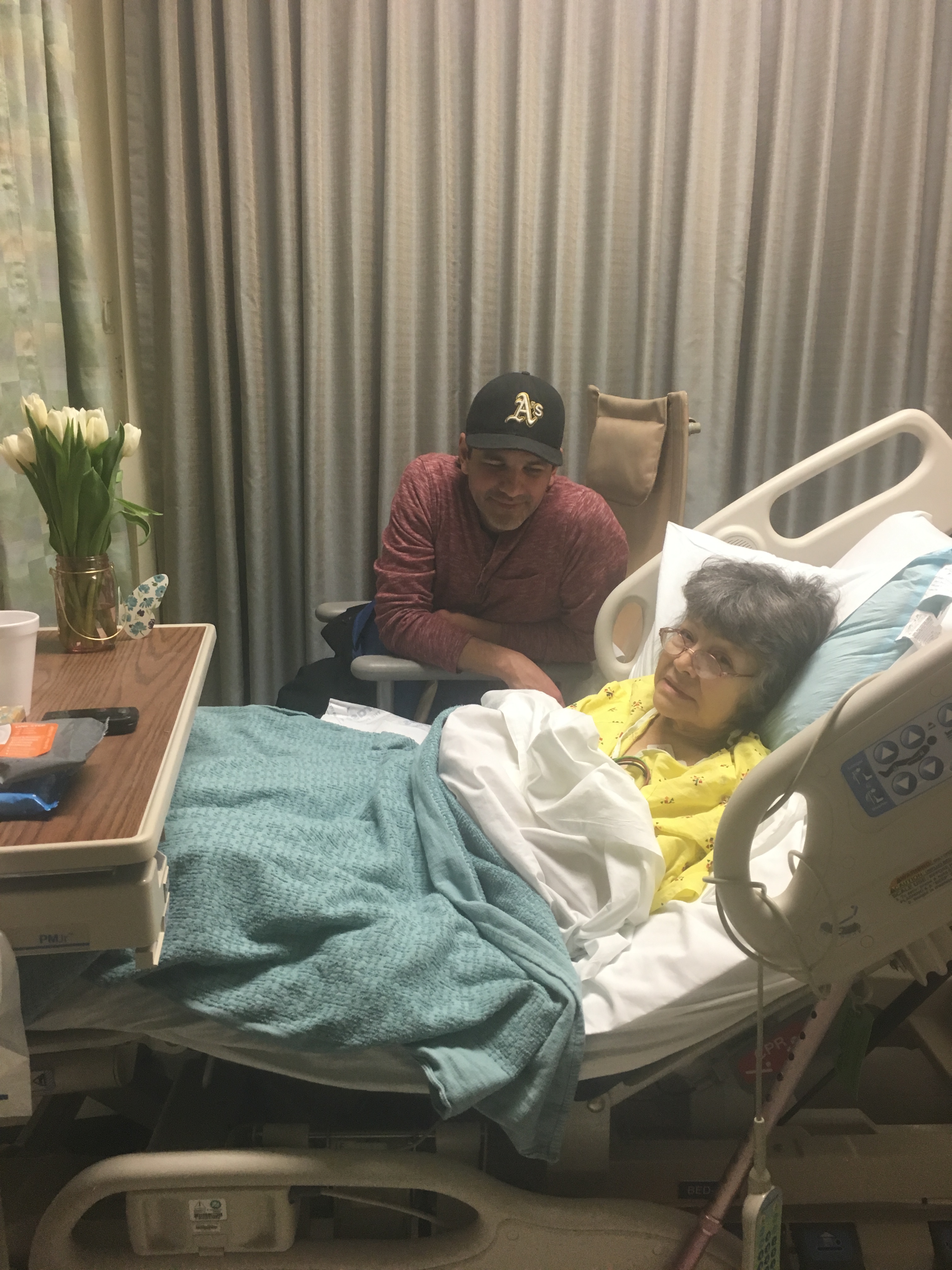
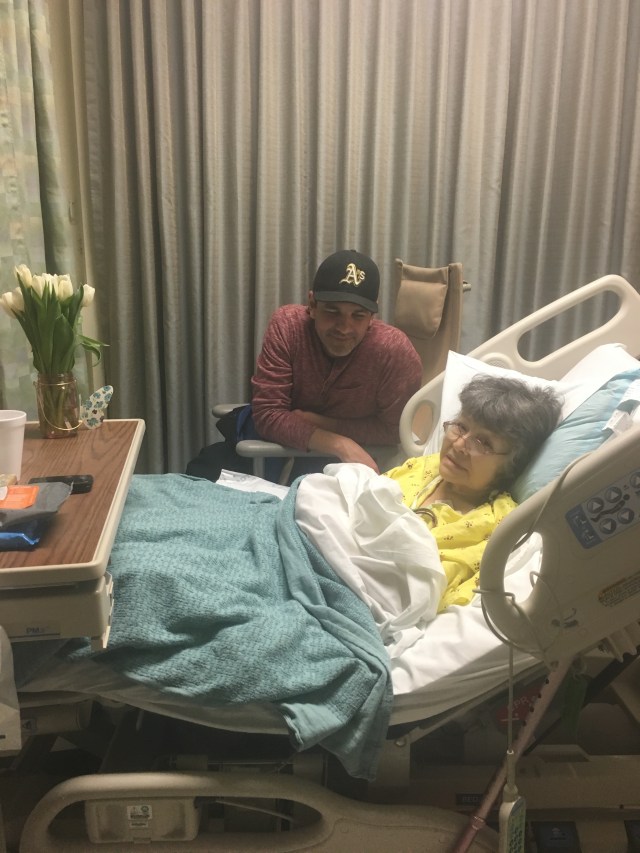
Restraints my mama was put in at a hospital.

My experience with my mom meets most of these “check boxes.” Over the course of many years, I lost my mom twice, once to her mental illness, the second time physically. In her last two years, the time she lived with me, her kidney disease would gradually take over. I witnessed her lose her physical strength and increasingly pre-age. And the violence? I saw, firsthand, how my mom was the victim of institutional discrimination, abuse and neglect. My heart broke over and over again, in many ways, in this whole ten year plus ordeal.

The sadness and guilt were as intense as I figured they would be, after my mom passed. But as I got better at navigating the murky waters of grief, I started to notice those other changes and problems.

For one, I was restless and uneasy. I would pace between rooms in the house at times. I didn’t recall ever doing that before, aside from the week my mom was in hospice. I liked to relax whenever possible. What was this about, I wondered?! I began noticing, too, that something was going on with my mind. Thoughts were racing and intrusive, and I would be a bit forgetful. I wasn’t able to “zone out” by just watching TV anymore. I had to, also, navigate and skim things on my computer, when watching a TV show. Memories and moments of despair played like songs on repeat in my mind, like the time my mom told me, about a month before she passed, that she didn’t have the strength in her hands to cut zucchinis for Albondingas soup. That was the last time she helped me in the kitchen.

I started to realize that it was like I was stuck. Stuck in my role as caretaker for my mom. Stuck trying to fight my hardest to keep her alive. Stuck dealing with, and often pushing back against, her doctors and hospital administrators, monitoring and assessing her condition every day, counseling her to take all her medicines, and then keeping her as comfortable as possible in hospice.

Yea, I was stuck. My body and mind didn’t know how to turn itself off or even how to lower the volume. Part of them, I’m sure, didn’t want to. I just wanted my mom back. How dare the system take her away from me, from us, so unjustly and prematurely! To accept my mom passing was to accept that we ultimately lost the “battle,” so to speak.

The restlessness, intrusive thoughts and hypervigilance I just described are classic symptoms of PTSD. I, thankfully, don’t have nightmares. But my sleep isn’t great. More than a year after mom passed, I still wake up a few times during the night, as if she’s still here. She’d wake me up, for different reasons, or I’d wake up to go check on her. And rare is the morning that I am able to sleep in past 7:00. I used to get up at that time, like clockwork, to give my mom her morning medicine. I can still be tired, but my racing thoughts won’t let me go back to sleep easily.

And irritability? Check. Anger? Check. While I experience these emotions at times, for what appears to be no logical reason at all, unrelenting intrusive thoughts summon them easily enough. As for flashbacks? Sure. When I see a homeless person or when I’m at a doctor’s office for a medical checkup, my blood pressure and anxiety easily rise. I’m back there, again, in some fashion.

IMG_0508
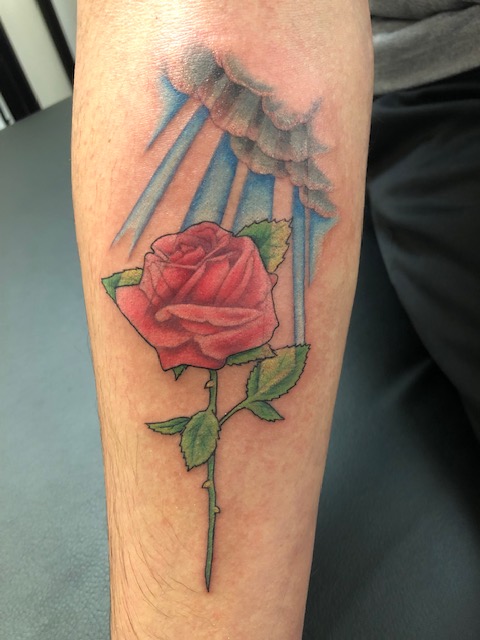
A tribute to mom: A rose, representing mom, going to heaven.

All this said, I am in counseling and doing my best to take care of myself. I was 8 months into my grief counseling when I started to see another counselor for more formal treatment. He would diagnose me with PTSD. I’m also experiencing low-level depression, which makes the self-care part of my healing hard sometimes (I have little motivation to cook), but my counselors say I’m doing very well, all things considered. Still, I know I need to find a meaningful purpose. I need to find peace. I need connection with others. I need understanding. It’s a long road and will probably always be a winding one. But I’ll persist and continue to heal because I know my mom would want me to.